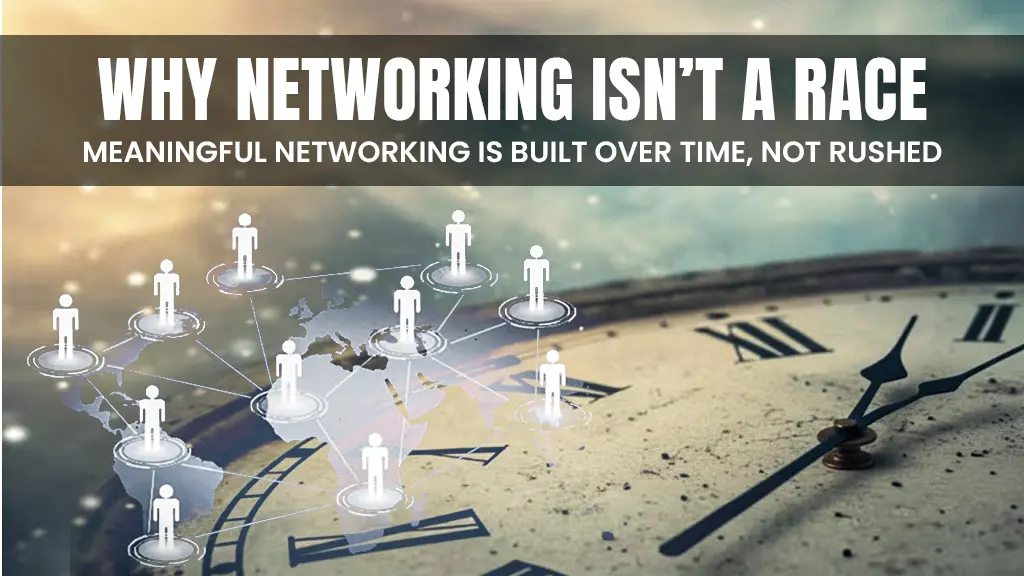
A reflection on “Networking Is a Marathon Not a Sprint” by Dr Ivan Misner, Phil Berg, and Bharat Daga and its quiet argument that relationships worth having can’t be rushed.
I watch members join BNI with this frantic energy that’s instantly recognizable because I remember having it myself.
The urgency to prove themselves. The pressure to make every conversation count. The mental scorecards after every meeting tallying whether the time was worth it.
When I was a member years ago, I thought the problem was effort. If I just followed up faster, stayed more visible, pushed a little harder, eventually something would click. When it didn’t, I assumed I was missing some tactic everyone else had figured out.
The one thing I never questioned? Whether I was moving too fast in the first place.
That thought came back to me while reading Networking Is a Marathon Not a Sprint by Dr Ivan Misner, Phil Berg, and Bharat Daga. The book doesn’t lecture or guilt you. It just quietly asks you to slow down long enough to notice how frantic you’ve become.
The central idea is almost annoyingly simple once you see it. Real networks aren’t built quickly. They’re built steadily. The same way trust has always worked. Through showing up repeatedly, through shared experiences, through being reliably present over time.
Here’s what I see happening with members constantly. They carry around this invisible pressure with networking. Every conversation has to matter. Every coffee meeting needs to lead somewhere concrete. And that urgency completely changes how you show up.
You stop really listening. You’re already thinking three steps ahead. You leave every interaction doing a mental audit of whether it was worth your time.
The book challenges that whole mindset without being preachy about it.
The marathon metaphor works because it actually mirrors how relationships happen in real life. You don’t sprint the first mile of a marathon trying to prove something. You pace yourself. You think long term. You trust that covering the distance matters more than any single burst of speed.
Every meaningful professional relationship I’ve built followed that exact pattern. None of them were rushed. They were built through consistency. Through showing up when it wasn’t convenient. Through staying in touch even when there was nothing obvious to gain from it.
The book is pretty direct about moving away from transactional thinking. When you treat networking like a vending machine where you put in effort and expect immediate results, people can feel it. The warmth drains out of conversations. Your curiosity gets narrow and self serving.
The authors make the case that real connection happens when you shift focus from “what can I get” to “how can I help.” And they don’t frame this as some idealistic philosophy. They frame it as practical strategy. People trust you more when you show up as steady and generous instead of urgent and calculating.
That trust, over time, becomes the foundation for actual referrals, real collaboration, legitimate opportunity.
What I appreciate most is how the book normalizes patience. It straight up tells you that results won’t always be immediate, and that’s not a bug in the system. That is the system. Relationships compound slowly, often invisibly, until one day you look around and realize how solid they’ve become.
There’s something relieving about hearing that, especially for newer members.
You stop obsessively measuring every interaction. You stop trying to force momentum that isn’t there yet. Networking starts feeling less like project management and more like just being a decent human over time.
The authors also make a clear distinction between consistency and intensity. Showing up regularly with genuine interest beats showing up once with massive energy and then vanishing. That shift alone changes how you think about visibility. It’s not about performance. It’s about continuity.
For anyone leading chapters or building communities, this perspective actually matters. When networking gets treated like a marathon instead of a sprint, the whole culture relaxes. Members feel less pressure to constantly impress and more freedom to actually connect. Conversations go deeper. Relationships get more authentic.
What you walk away with isn’t some tactical playbook or script. It’s more like a quiet recalibration. You start examining how you’ve been approaching people and whether speed accidentally replaced presence somewhere along the way.
You begin seeing networking less as this thing you have to do and more as a long term investment in relationships that actually deserve your care. You get comfortable with the idea that not every effort produces instant returns, and that doesn’t mean the effort was pointless.
The book doesn’t promise you’ll suddenly have a massive network next month. It offers something more useful. A way of thinking that lets relationships grow naturally without all the strain and constant evaluation.
By the end, networking feels less exhausting. Less like theater. More human.
And maybe most importantly, more aligned with how trust actually gets built in the real world.
Sometimes the best lesson isn’t learning how to move faster. It’s learning to slow down enough to actually stay in the race.