Have you ever been in a meeting, fully present, sharing an idea you care about, when you suddenly notice someone across the table glance at their phone? Or worse, you see a slight frown, a distracted look, eyes drifting away. Nothing is said. No objection is raised. But something inside you reacts. You keep talking, yet part of your mind is no longer in the room. If you’re honest, you’ve already started telling yourself a story.
This is exactly where my own experience begins.
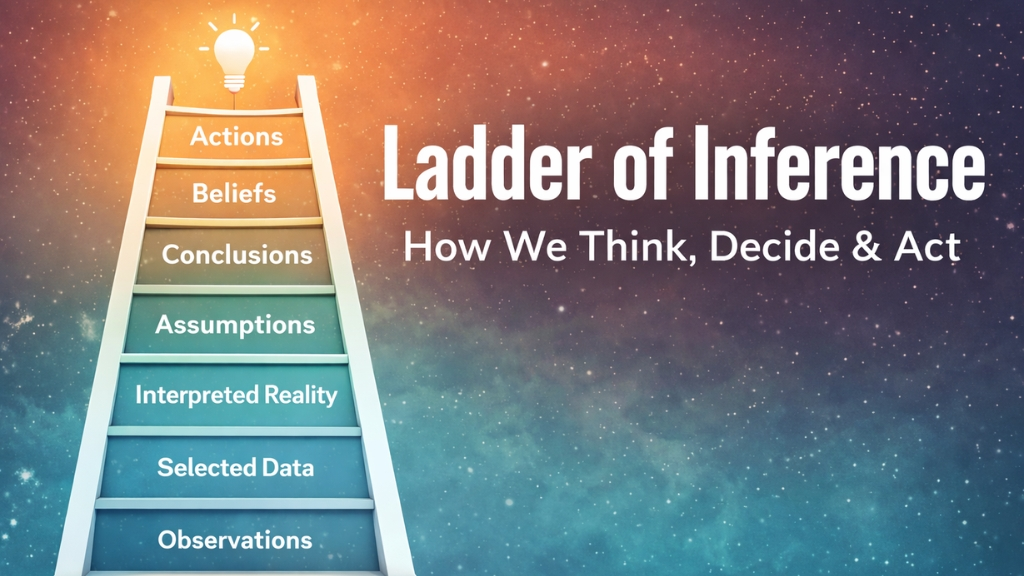
A while ago, I was in a meeting presenting a thought I genuinely believed in. As I spoke, I noticed a few people exchanging looks. One person seemed withdrawn, another distracted. No one interrupted me, no one disagreed openly, yet my mind latched onto those small signals. I observed data—body language, silence, and a lack of engagement. That was all.
But I didn’t stay with observation. I made a belief.
Almost instantly, meaning crept in. They’re not aligned. They’re unhappy with this direction. Maybe they’ve already made up their mind. From there, assumptions formed quietly but confidently. I assumed resistance. I assumed judgment. And without realizing it, I drew a conclusion: these people are not on my side.
That conclusion didn’t stay isolated. It shaped how I engaged with them afterward. I became more guarded. More transactional. I stopped asking open questions and started filling in the gaps myself. Over time, this created a loop. My belief shaped my behavior, and my behavior limited what I could see or hear. I never actually confirmed my assumptions—I simply lived inside them.
Weeks later, the truth surfaced.
The story on the other side was completely different. The distraction I had interpreted as disengagement had nothing to do with me or the idea. One person was dealing with a serious family situation. Another was mentally preoccupied with a personal crisis they were carrying quietly into the room. There was no resistance. No hidden judgment. Only human beings manage challenges I had never thought to ask about.
That realization was uncomfortable—but clarifying.
It was around this time that I came across the Ladder of Inference, and suddenly, everything made sense. I could see my own thinking laid out step by step. I had observed limited data, selected what stood out to me, added meaning based on past experience, made assumptions, formed beliefs, and acted on them—all without ever checking whether the story in my head matched reality.
Understanding this concept changed the way I think and lead.
I began slowing down my reactions. I started separating what I saw from what I assumed. Most importantly, I learned to ask questions rather than draw conclusions. Simple questions. Human questions. Questions that invite clarity instead of reinforcing belief.
The Ladder of Inference taught me that most misunderstandings are not caused by malice or incompetence, but by untested stories. When we don’t pause to examine how we think, we mistake interpretation for truth—and lose the opportunity to truly understand one another.
Today, whenever I notice myself reacting strongly to silence, distraction, or body language, I pause and ask: What do I actually know? What am I assuming? What else could be true? That pause has changed not just conversations, but relationships.
Sometimes growth doesn’t come from being more certain. It comes from being more curious.
Pankaj Gupta